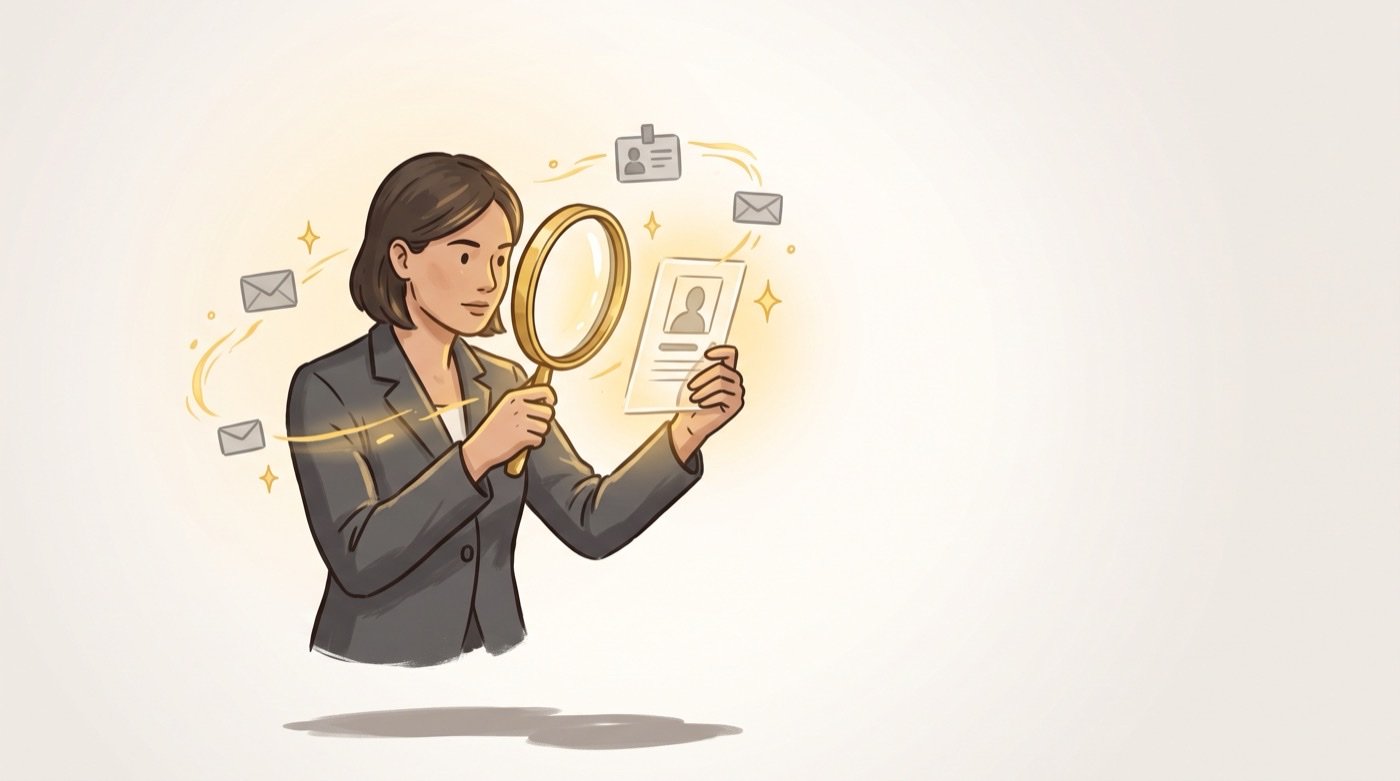
Every week something lands in the inbox that wants a warm reply. A cold client. A “let’s partner” DM. Someone who’d be perfect for that contract role. And, increasingly, a bot doing the pitching on someone’s behalf.
Most of them are fine. Some are real people making themselves sound bigger than they are. A few are inventing the whole thing. The problem is they read the same on first contact: confident, specific, a little flattering. You can’t tell them apart by tone, because tone is the one thing a fabricator gets right.
So before you reply warmly, hire, sign, or endorse, spend ten minutes on the public record. Not because everyone’s lying. Because checking is cheap and being wrong is expensive.
Start with the domain
The single best check costs nothing. A domain remembers when it was born. Run a WHOIS lookup on the company’s website and it hands you the registration date. A firm claiming two decades of history on a domain registered eighteen months ago has just told you something it didn’t mean to.
That one line often settles the question before you’ve read a word of their pitch.
A few more, none of them exotic
The rest of the tells are just as public and nearly as fast:
- The team page. Count the real, named humans. If the “team of forty” is a grid of glossy portraits with first-name-only captions and faces that all share the same lighting, you’re looking at stock photos or AI-generated headshots.
- The titles. Search the name and the title together. A genuine “CIO of a $300M company” leaves a trail: conference talks, press, a LinkedIn that other people have engaged with. A title invented last Tuesday returns their own website and nothing else.
- The LinkedIn dates. The headline says founder and CEO. The work history says analyst until eight months ago. The gap between the two is the finding.
Each of these is a public source anyone can reach in a browser. None of it touches their private life or asks you to do anything you wouldn’t do to a supplier before wiring them money.
Most of them aren’t fake
Here’s the honest part, because this is where due diligence tips into paranoia if you let it. The large majority of what you’ll find isn’t a scam. It’s inflation. A real person with a real, modest business who has rounded everything up: the solo consultancy that became “a global advisory group,” the side project that became “our flagship product,” the recent certificate sitting next to “20+ years of experience.”
That’s not a reason to walk away. Plenty of good people oversell. It’s a reason to price the relationship correctly. Read “$300M company” as “one determined founder,” and set your terms, your expectations, and your payment schedule to the real thing rather than the billboard.
Outright fabrication is rarer. The fully synthetic pitch is rarer still: an AI avatar, an invented name, a bot writing in the first person with no human behind it anywhere. But that case is growing, and it’s the one where walking away is the only sensible move. The check that catches the harmless inflator is the same one that catches the bot. You run it once and it sorts both.
Due diligence, not suspicion
None of this asks you to become an investigator or to treat every new contact as a threat. It’s the same instinct you already apply to a contract or an invoice. You read it before you sign it.
The move is to do the reading before the relationship, not after it goes wrong. A WHOIS date, a couple of searches, a real look at the team page. Ten minutes, in front of the reply, not after the deposit has left your account.
We built a small tool for this, vet-superpowers, because doing it by hand every time an “urgent partnership” showed up got old. But you don’t need it to start. You need the habit: check first, warm up second.
The stranger who’s genuinely who they say they are won’t mind the wait. The one who minds is the one you were about to learn about the hard way.
If something’s landed and you can’t tell what you’re dealing with, get in touch.